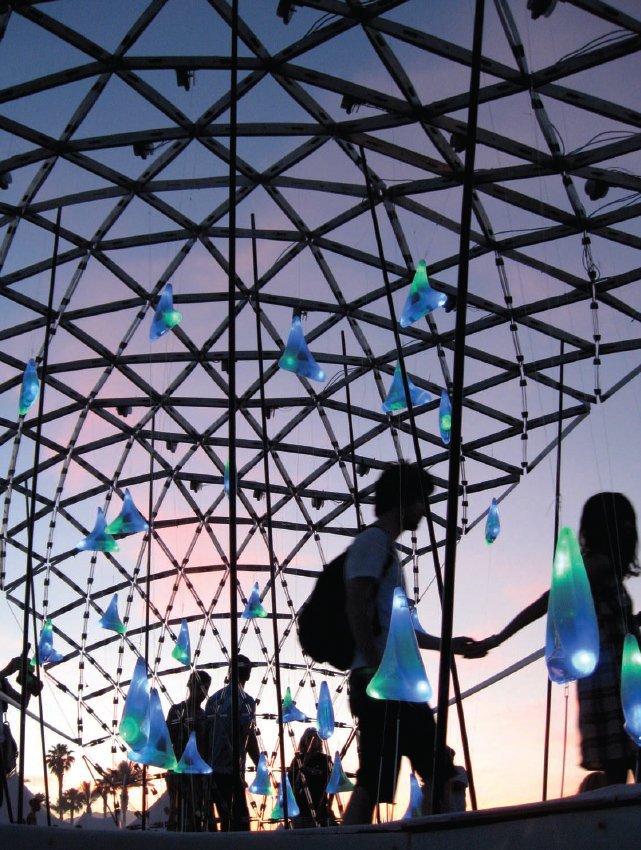
Flockwall by CalPoly Pomona Architectural students+Michael Fox
The design process was implemented from an architectural (as opposed to engineering) standpoint. The final module assemblies were extrapolated to simulate various architectural applications of space-making. This aspect is unique from engineering approaches to modular robotics in speculating how such an approach to adaptive space-making can be applied in realistic situations. The modules did have several real constraints that had to be considered in the development including: 1) Weight 2) Power 3) Lighting, and 4) Mechanics. It was important that each module had self-contained lighting for which 2700MA batteries were used to power three LED lights for up to 15 hours at at time. It was also important that each module could be opened quickly like a clamshell to repair mechanical problems and change batteries. With these issues in mind the module was formed out of two lightweight shells of plastic. Once a final CNC was made a negative PVC mold was created from which hundreds of the final shells could be vacuum-formed.